
The 0.318 mW Wearable System That Tracks Motion With 99.83% Accuracy
A research team in India reports a six-sensor stretchable sensing layer worn over clothing that classifies human motion with 99.83% accuracy on trained users while drawing just 0.318 mW of power — a combination that could unlock always-on wearable motion capture for clinical and industrial settings.
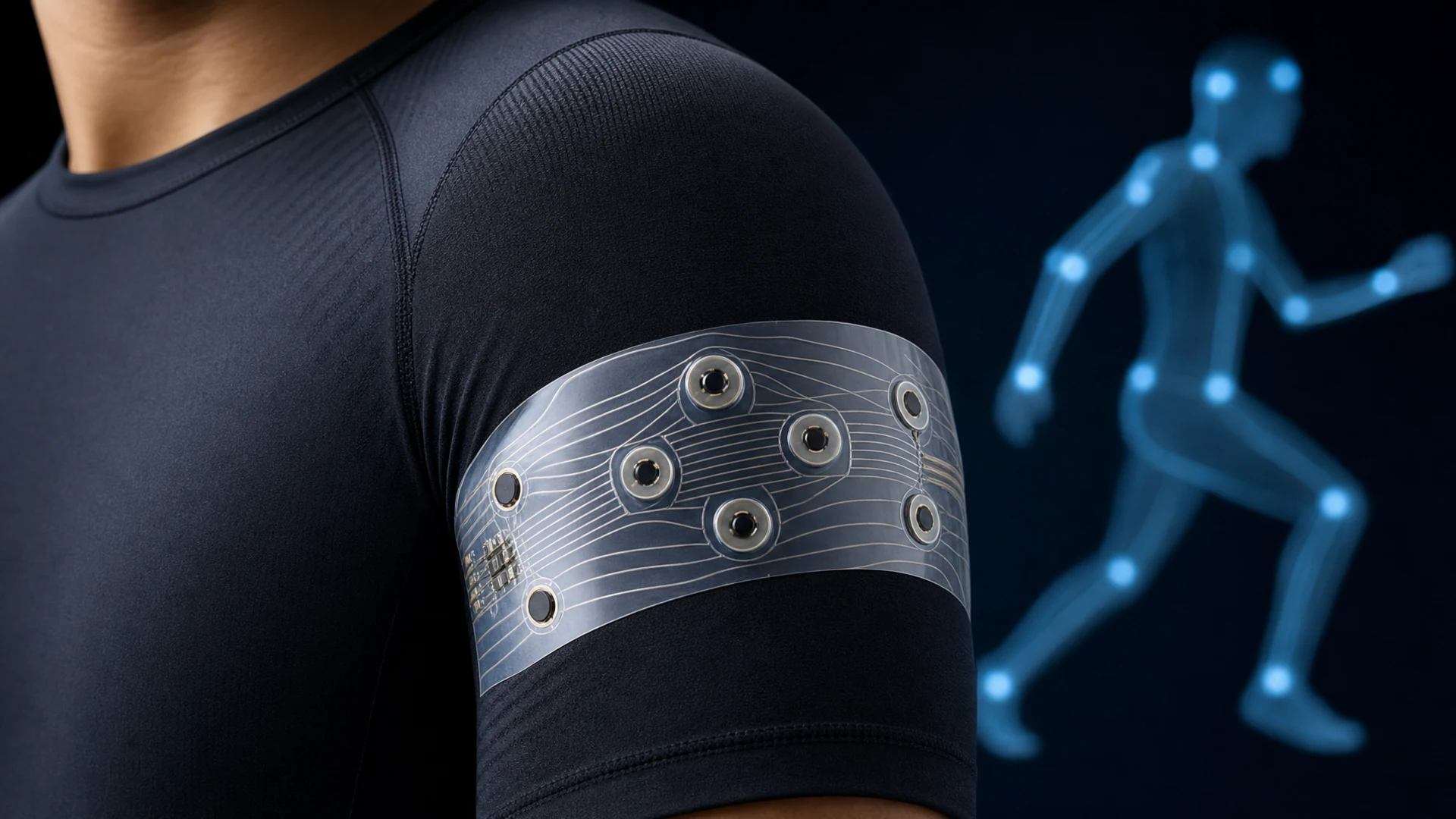
Wearable motion capture has long been stuck between two trade-offs: accuracy and battery life. A research team in India reports a sensing layer worn over regular clothing that may sidestep both. In results published 3 August in the peer-reviewed IEEE Sensors Journal and reported in IEEE Spectrum on 5 September, the system classified human movement with 99.83% accuracy on trained users while drawing just 0.318 milliwatts across all six sensors.
What the system does
The design uses six highly stretchable piezoresistive sensors positioned over clothing at the hips, knees, and ankles. As the body moves, the sensors deform and translate those deformations into electrical signals. A machine-learning algorithm running on a microcontroller then evaluates how all the joints move together, instead of treating each sensor as an isolated measurement.
In the study, 12 participants performed four types of motion: walking on flat ground, walking on inclines, climbing stairs, and descending stairs. After a short per-person training pass, the model classified these activities with 99.83% accuracy. When tested on a participant who had never worn the system, accuracy still reached 89%.
The sensors are built to endure repeated strain. According to the report, they withstood more than 12,000 stretch cycles to three times their original length, a durability indicator that matters for long-term use outside the lab.
Why the power number matters
Always-on wearable sensing has historically been constrained less by sensor accuracy than by energy. High-resolution inertial or electromyography systems drain batteries quickly, forcing users to choose between rich data and practical wear time. The Indian team’s approach inverts that equation.
In total, the six sensors required 0.318 milliwatts of power. “It is an extremely low power requirement for the sensing layer and can easily be supplied by a small battery,” Arora, a member of the research team, told IEEE Spectrum.
Pair that power budget with on-clothing placement, and the practical advantages become clear for B2B buyers. Mounting sensors over clothing removes skin-contact requirements and simplifies hygiene and cleaning protocols in shared-use environments such as rehabilitation clinics, sports performance labs, and occupational ergonomics programs. Low power consumption also means smaller batteries and longer field operation, which translates into fewer recharges, lower service overhead, and lighter devices for the end user.
Because the machine-learning inference runs on a microcontroller, classification can happen at the edge — no cloud round-trip, no continuous wireless streaming — which further reduces energy use and keeps movement data local. For wearable OEMs and system integrators, that combination of stretchable sensing, edge inference, and milliwatt-class power is a compelling foundation for next-generation activity monitors.
Material limitations to watch
The headline accuracy deserves context. The 99.83% figure was measured after per-individual training, while the 89% result on a never-worn user shows a notable generalization gap of more than ten percentage points. Teams deploying such a system would need to budget for a short calibration session with each new wearer, or accept lower out-of-the-box accuracy.
The study itself was also narrow: 12 participants, four scripted activity types, and controlled conditions. Daily life includes far more varied movement, and the published work describes activity classification rather than continuous joint-angle measurement or fall detection. Long-term reliability in sweat, rain, and repeated washing also remains unproven at this stage. The sensor count is small, so resolution across more complex multi-joint motions should be examined carefully in future validation studies.
It is also worth noting that Arora’s quote describes the sensing layer’s power draw; the microcontroller’s contribution sits outside that figure. Buyers evaluating system-level power claims should ask about the full signal chain, not just the sensors.
Takeaways for technology buyers
For now, this is research hardware, not a purchasable product. But the results point to three practical signals for B2B readers. First, stretchable, over-clothing sensing is maturing to the point where the sensing layer itself is no longer the bottleneck — 0.318 mW is a tiny footprint for a six-point body-motion capture setup. Second, edge-based machine-learning classification makes privacy-sensitive motion analysis feasible without cloud dependency. Third, procurement teams should weigh the per-user calibration trade-off against their accuracy requirements: 99.83% after training is excellent, but the zero-training 89% result defines the real-world baseline.
Companies scouting wearable motion technology should treat this as a promising validation milestone, request follow-up studies with larger and more diverse participant groups, and benchmark the sensors against inertial measurement units in their own use cases before committing to a hardware platform.
Updated September 6, 2026