
Google sets a 2027 deadline to move every Pixel device out of China
Google told suppliers it will shift all Pixel phones, watches and earbuds out of Chinese factories by 2027, leaning on Vietnam and India. Here's what the exit means for the mobile supply chain.
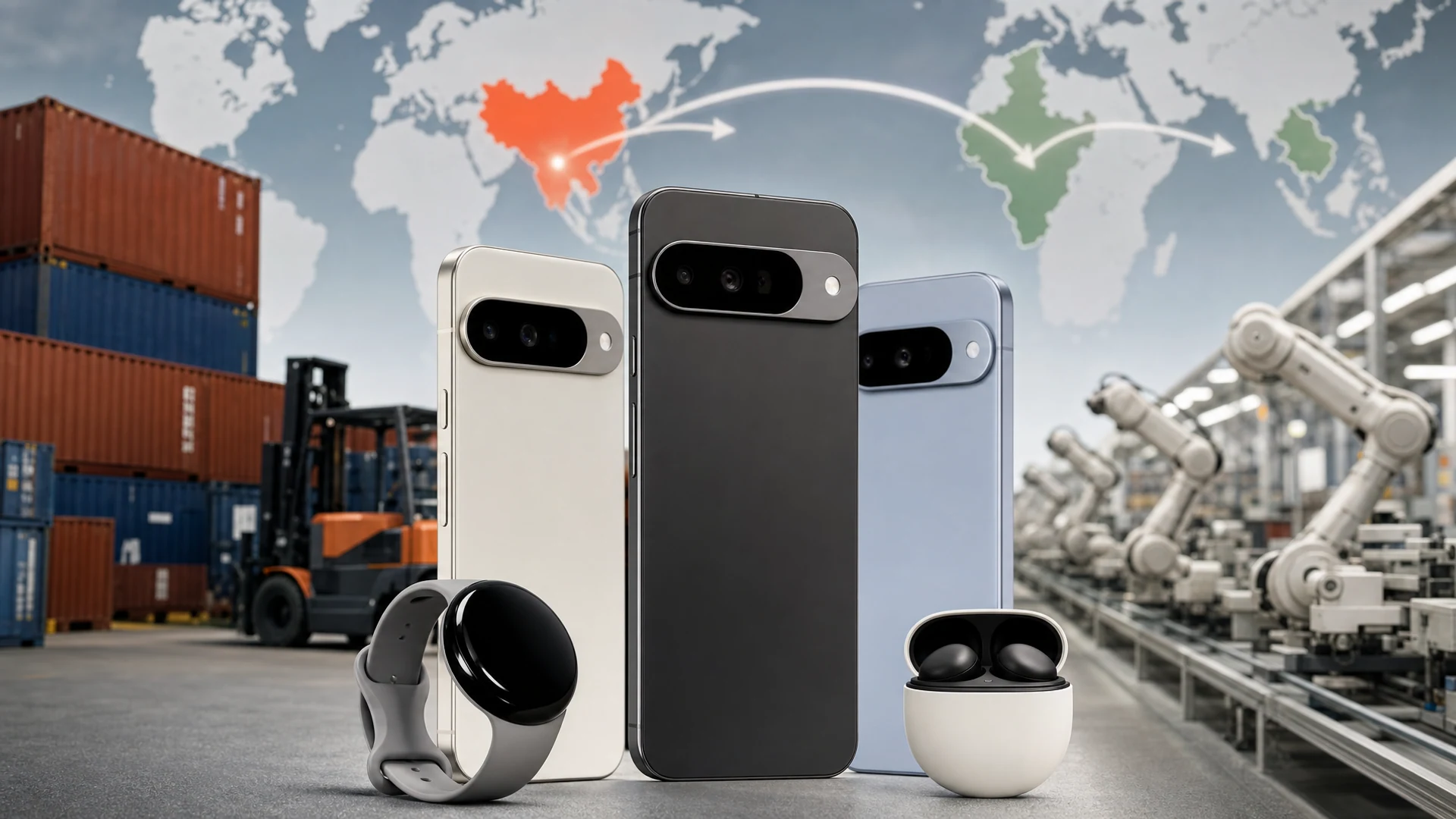
Google has told its suppliers it plans to shift production of all Pixel devices — smartphones, smartwatches and wireless earbuds — out of China, with the move starting next year and targeted for completion in 2027, Nikkei Asia reported on August 18. Vietnam and India are the designated manufacturing destinations. Google has not publicly commented on the report.
What changed, and why now
This is not a new ambition. Reports of Google moving Pixel manufacturing toward Vietnam have been circulating since roughly 2019, and the company has spent years quietly expanding capacity in Vietnam and India while most Pixel assembly stayed in China. What makes this plan different is the proof point behind it: the Pixel 11 series, which launched last week, was reportedly both developed and produced entirely in Vietnam — the first high-end Pixel line built fully outside China. Nikkei reported in January that Google planned to develop and build the Pixel 11 in Vietnam; that bet appears to have paid off.
The logic is straightforward. Manufacturing a flagship smartphone is more complex than producing a smartwatch or a pair of wireless earbuds. If Google could build its most demanding device in Vietnam, management apparently concluded the rest of the catalog could follow. According to the report, that milestone is what gave Google the confidence to set a hard 2027 deadline for everything else.
The scope, and the numbers
The plan reportedly covers the entire Pixel catalog: phones, watches and earbuds. Google has told suppliers it wants all of them manufactured outside China beginning next year. Vietnam is expected to anchor high-end smartphone production, while India continues to grow as a hub for budget-tier assembly — Google currently works with Foxconn in Tamil Nadu and Dixon Technologies in Uttar Pradesh to build its more affordable Pixel models.
The volume behind the move is real but contained. Google shipped roughly 12 million Pixel phones in 2025 and has reportedly told suppliers to plan for an 8–10% increase in 2026 — on the order of 13 million units. That is still a modest share of the global smartphone market, but it is enough volume to make production decisions consequential, especially as Google pushes further into premium and enterprise hardware. If the plan is completed, Google would become the second major global smartphone brand after Samsung to shift all handset production out of China.
What it means for business buyers
For B2B buyers and channel partners, the shift matters in three concrete ways.
Resilience. A dual-hub model spanning Vietnam and India reduces the single-point-of-failure risk that concentrated manufacturing creates. Enterprises procuring Pixel fleets get a supply base that is geographically distributed and easier to rebalance if one region is disrupted.
Proximity. Producing in Vietnam and India puts assembly closer to some of the fastest-growing smartphone markets, which can shorten logistics chains, cut shipping times and simplify regional distribution — practical advantages for wholesalers and enterprise resellers that move devices in volume.
Supplier economics. Contract manufacturers like Foxconn and Dixon Technologies stand to gain a larger role, while component suppliers face the harder task of reconfiguring flows to serve new assembly sites. For procurement teams, that means watching for capacity announcements and potential shifts in lead times, pricing and regional availability as the transition plays out.
The material risks
The plan is a target, not a done deal — and it carries execution risk. Vietnam and India must absorb volume that currently rolls out of Chinese factories, and ramping advanced smartphone production in newer ecosystems takes time. Quality control during a migration of this scale is another known hazard: moving high-end assembly before the supply base is fully mature can create yield and consistency problems. The report also notes that the plan has been communicated to suppliers but not confirmed by Google, so the 2027 timeline could slip.
For business buyers, the near-term implication is simple: during the transition, expect possible pockets of availability or pricing volatility in Pixel hardware, and factor that into procurement planning rather than assuming the move will be seamless.
The takeaway
Google’s Pixel supply chain now has a hard deadline, and the industry will be watching whether the Vietnam playbook scales. For enterprises, the story is less about headlines and more about a practical question: where your devices are made, how resilient that network is, and how quickly it can adapt. The companies that treat supply chain decisions as strategic — rather than transactional — will be the ones that benefit when a transition like this lands.
Updated August 19, 2026