
Samsung's Galaxy Z Fold 8 breaks the 3 million-won mark as AI memory demand rewrites phone costs
Samsung began carrier sales of the Galaxy Z Fold 8 in Korea with record pre-orders, while the top 1TB versions crossed 3 million won for the first time in a mass-produced phone lineup. Here's how the AI memory boom is reshaping device costs and B2B buying decisions.
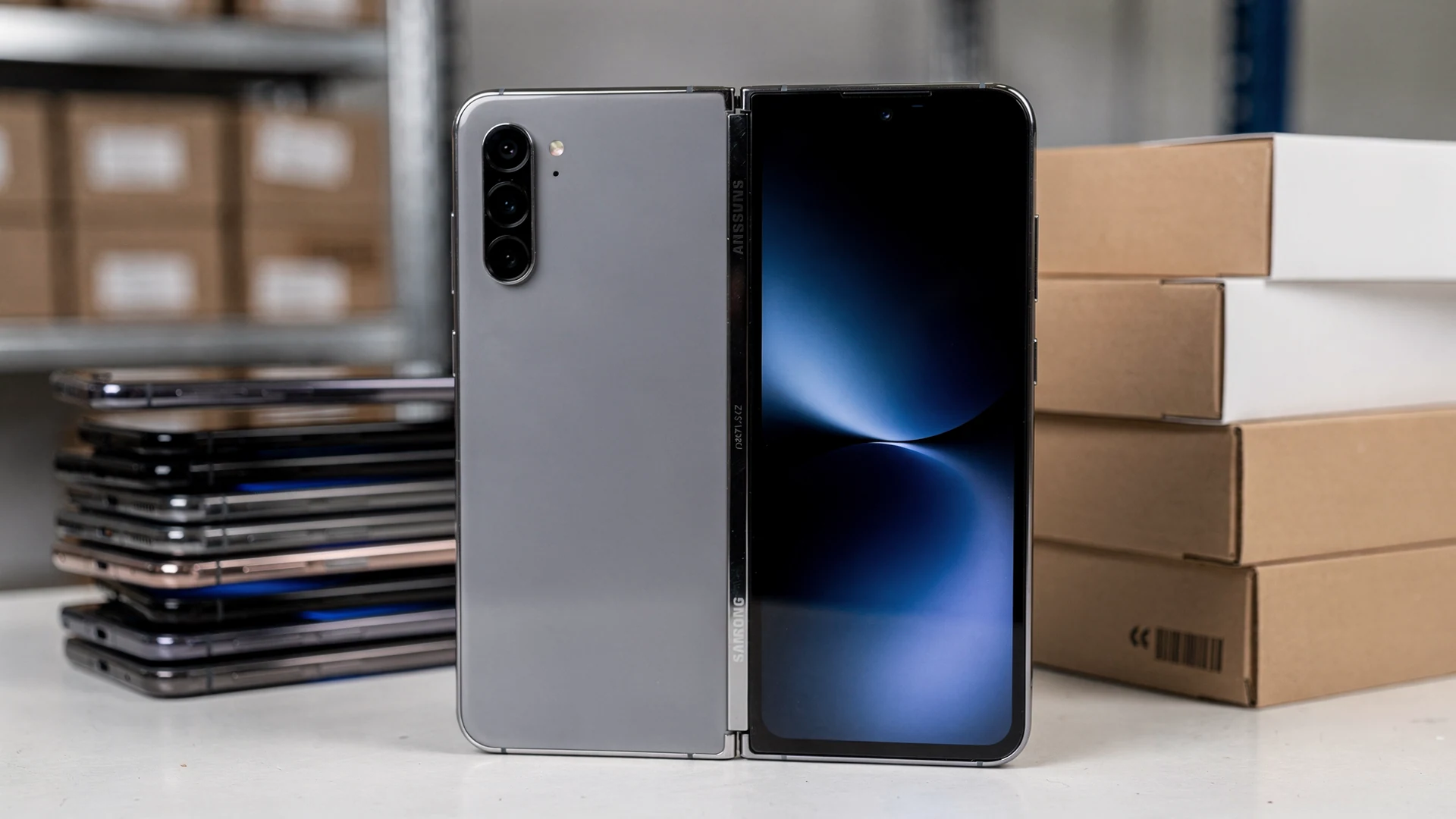
Samsung’s Galaxy Z Fold 8 breaks the 3 million-won mark as AI memory demand rewrites phone costs
Samsung Electronics opened carrier sales of its Galaxy Z Fold 8 series in Korea on Aug. 4 with record pre-orders — and a new price ceiling. For the first time in a mass-produced smartphone lineup, the top 1TB versions of both the Galaxy Z Fold 8 and Fold 8 Ultra carry prices above 3 million won. The reason isn’t mostly the foldable display. It’s memory.
What happened
The unlocked retail prices announced at launch were already high: 2.5773 million won for the 256GB Fold 8 Ultra and 2.2781 million won for the 256GB Fold 8, with 512GB versions at 2.8303 million and 2.5311 million won. But the 1TB configurations cross into a new psychological and commercial territory, exceeding 3 million won. The only earlier Samsung foldable above that was the Galaxy Z Tri-Fold at around 3.5 million won, released in very limited quantities as a concept product. The Fold 8 generation is the first volume smartphone family to enter that range.
Demand is strong anyway. Samsung says the Z8 series — Fold 8 Ultra, Fold 8, and Flip 8 — logged 1.44 million pre-orders in Korea during the seven-day window ending Aug. 3, a Galaxy record and roughly 140 units per minute. Korean carriers SK Telecom, KT, and LG Uplus activated devices for pre-order customers starting Aug. 4, with general sales from Aug. 7 and common subsidies from 265,000 to 500,000 won depending on plan.
The chipflation driver
The pricing pressure parallels a global memory market spike. Market research firm DRAMeXchange reported that the average fixed transaction price of general-purpose PC DRAM (DDR4 8Gb) reached $24 in July, up 14.3% from June. NAND flash for memory cards and USB drives averaged $30.1, up 4.3% month over month and the 19th consecutive monthly increase since December 2024.
The root cause is the AI buildout. “Exploding investments in AI servers have caused bottlenecks in mobile memory supply,” SBS News noted. Memory makers are shifting capacity and product plans toward high-margin data-center components as cloud service providers pull server memory demand. TrendForce says DRAM makers plan to cut PC DRAM supply next year to respond to that server demand, and forecasts PC DRAM fixed transaction prices up 15% to 20% in Q3 from Q2.
The result: memory’s share of a smartphone’s bill of materials has surged. According to market analysis cited in the SBS report, memory accounted for about 14% of total component costs in an $800-tier phone in Q1 of last year; by Q2 of this year it had jumped to roughly 40%.
Why it matters for B2B buyers
For procurement, finance, and product teams, this isn’t a consumer curiosity. Handset makers are making storage trade-offs in a market where DRAM and NAND prices are at records. Suppliers that provision fleets, kiosks, rugged devices, or field hardware will face higher refresh costs, longer device lifecycles, and more negotiation pressure around memory configurations.
Carrier subsidies and trade-in compensation soften the initial price shock but don’t fix component economics. Enterprise buyers should expect ASPs to stay high and watch for memory price indicators, not just handset list prices, when forecasting hardware budgets. The era of cheap incremental storage is over for now.
Risks to watch
The obvious risk is demand destruction. Even with record pre-orders, prices at this level can push buyers — especially businesses managing fleets — to stretch upgrade cycles. Market concentration is another vulnerability: a handful of memory vendors effectively set the cost curve for every device maker, and AI data center demand is less price-sensitive than consumer demand, making smartphones the residual buyer. That imbalance could persist through 2026.
The useful takeaway: if your organization depends on high-capacity mobile hardware, plan for memory-led price increases, evaluate storage tiers carefully, and consider locking in supply agreements while device vendors still offer pre-order subsidies. The 3 million-won phone is not a limited edition — it’s a signal that memory has become a strategic procurement issue.
Updated August 5, 2026